The workplace should be where professionalism is held to the highest standard, but that may not always be the case. While most people try to be respectful in the workplace, there are times where colleagues show little regard for the people they work with. Or worse, they treat them differently for their own personal gains.
Seeking to impress higher-ups or to get out of trouble, malicious coworkers may resort to gaslighting: a psychological manipulation tactic used to make someone question their own thoughts. They may go out of their way to convince the victim that they are “overreacting” or that they “remembered it wrong.”
If this feels familiar to you, there’s a chance that you may have been gaslighted in your workplace.
The signs can be subtle, but your feelings never lie. To help you recognise if you're being gaslighted at work, here are some common phrases and behaviours to watch for.
Note: this may trigger some workplace PTSD.
1. “I never said that”
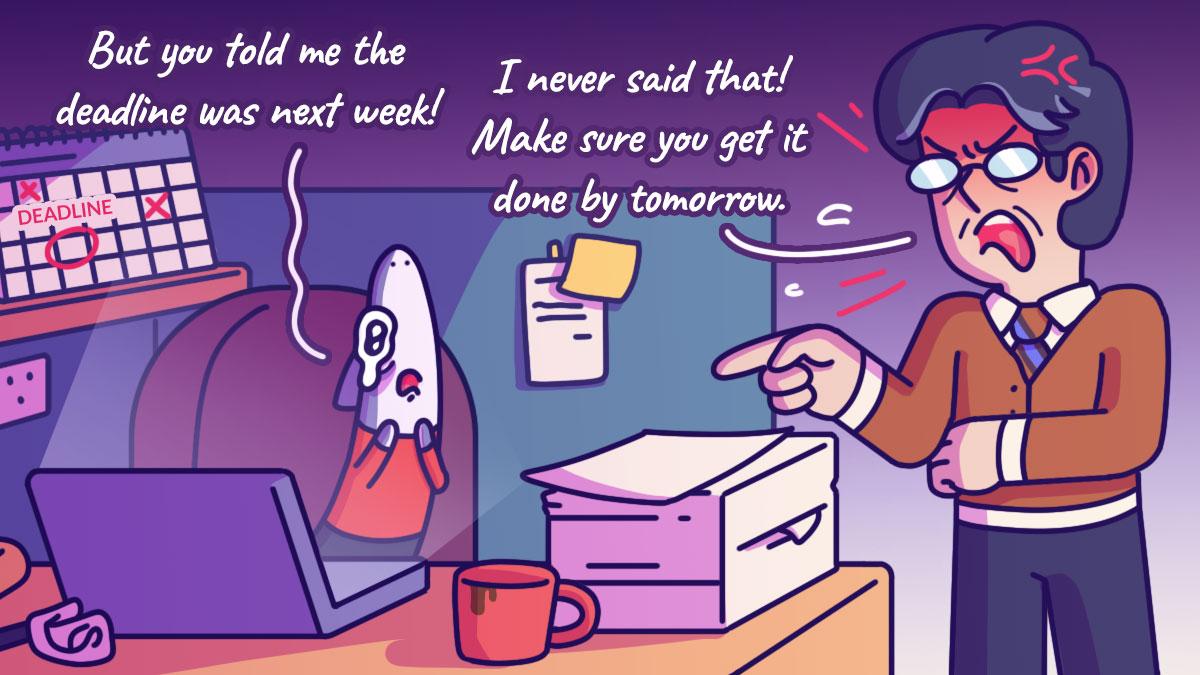
This is one of the most common gaslighting tactics used by manipulative colleagues and superiors. They may state something to you but dismiss its validity when you mentioned it later.
For example, your colleague might share a deadline for a campaign with you, but when it is time to deliver, they act like the deadline was never mentioned.This forces you to question your memory and second-guess future information that is shared with you. If you’ve experienced this, it’s possible that your coworker was trying to gaslight you into doubting yourself. One of the best ways to protect yourself is to keep a written trail. Try following up on conversations with a brief email. Having documented records can help you refer back to what was actually said, so nothing can be twisted next time.
2. "This is on you”
To make themselves look good for the superiors, gaslighters almost never own up to their mistakes. They would deflect, deny, and pass the blame to the most convenient victim, which unfortunately, could be you.
Colleagues who consistently refuse to take accountability for their mistakes and instead blame you for not reminding them or checking their work can make you feel as though you are always failing. Over time, this can lead to lower self-esteem and reduced confidence in your work.
If someone accuses you of something, it’s important to stand up for yourself. However, since this is the workplace, how you do it matters. The key is to respond calmly and professionally, without making it personal. Stick to the facts, and if you have documentation or evidence, use it to support your case. Standing up for yourself not only protects your reputation but also shows others that you are confident and not someone who can be easily pushed around.
3. “You’re overreacting”
If anyone has ever said that to you, they are dismissing your feelings on the matter. Phrases like “You’re being dramatic,” or “Your other colleague didn’t react like this so why would you?” all sing the same tune.
These statements are meant to downplay your concerns and avoid accountability. To support their case, they would also mention that other workplaces are like this and tell you to “suck it up”.
Don’t believe them: not every workplace is like this. Regardless of rank, we are supposed to respect every coworker, and acknowledge their feelings. A healthy work environment values open communication and addresses problems without judgement because that is how employees and organisations grow.
You may not be able to stop gaslighting entirely, but you can take proactive steps to protect yourself. Remember to document everything you and your coworker said, and avoid being overly emotional during your interactions, as it can be used against you. If the behaviour continues, you can present this documented proof to HR or to a trusted superior.
4. “Sorry, I forgot to loop you in again”
While there may be times when your coworker simply forgets to loop you in, if it happens frequently, it could be a sign of gaslighting behaviour. Gaslighters often “forget” to invite their victims to meetings or leave them out of important email threads. Their reasons for doing so may be to undermine your credibility, keep you out of key decisions, or engage in a power play.
Over time, victims will appear uninformed and kept out of the loop, and eventually, even overlooked for any promotions. So, if you believe that your coworker may be “forgetting” to invite you to important meetings on purpose, here’s what you need to do:
You need to clarify your role and remind the team that you should be involved in any discussions related to the project. When you are confronting the gaslighter, please address the issue directly by having a private conversation with him or /her, but stay calm while doing so.
5. “That’ll never work. We tried it before”
You wouldn’t constantly undermine a colleague’s suggestion, so if someone is doing this to you repeatedly, it may be a form of gaslighting. Subtle signs include publicly dismissing your suggestions, frequently interrupting you mid-sentence, or downplaying your ideas.
This may happen more during meetings with higher-ups, as gaslighters use these opportunities to cast you in a bad light. But stay calm! Getting defensive is what your gaslighter wants you to do so they can use your emotional reactions as a reason to further undermine you.
Be prepared to back up your ideas with data and examples. Having facts and figures makes it much harder for other to dismiss your suggestions. If you’re rudely interrupted, let the person finish speaking, then politely reclaim the conversation by returning to your point.
6. “You didn’t mention that” (though you did)
A classic workplace gaslighting behaviours is selective listening, where coworkers would cherry-pick instructions or requests they want to acknowledge. They would only respond to the part that benefits them, conveniently leaving out the rest. To make matters worse, they may accuse you of not providing the full details, even though you did.
As mentioned earlier, documentation is your best friend in the workplace. With proof, you can clear yourself of any accusations and hold your colleague accountable for their mistakes. It also helps to have them repeat your instructions so there will be no miscommunication between both parties.
Resolving gaslighting with a colleague is never easy, but it is important to do so in a professional manner. This helps you protect your reputation while maintaining a strictly professional relationship with your gaslighting coworker. But above all, your mental health should always be your priority, so if a toxic work environment is no longer serving you, it is also okay to walk away.